Read Before You Sign: The Warranty Language That Leaves UK Businesses Paying Twice
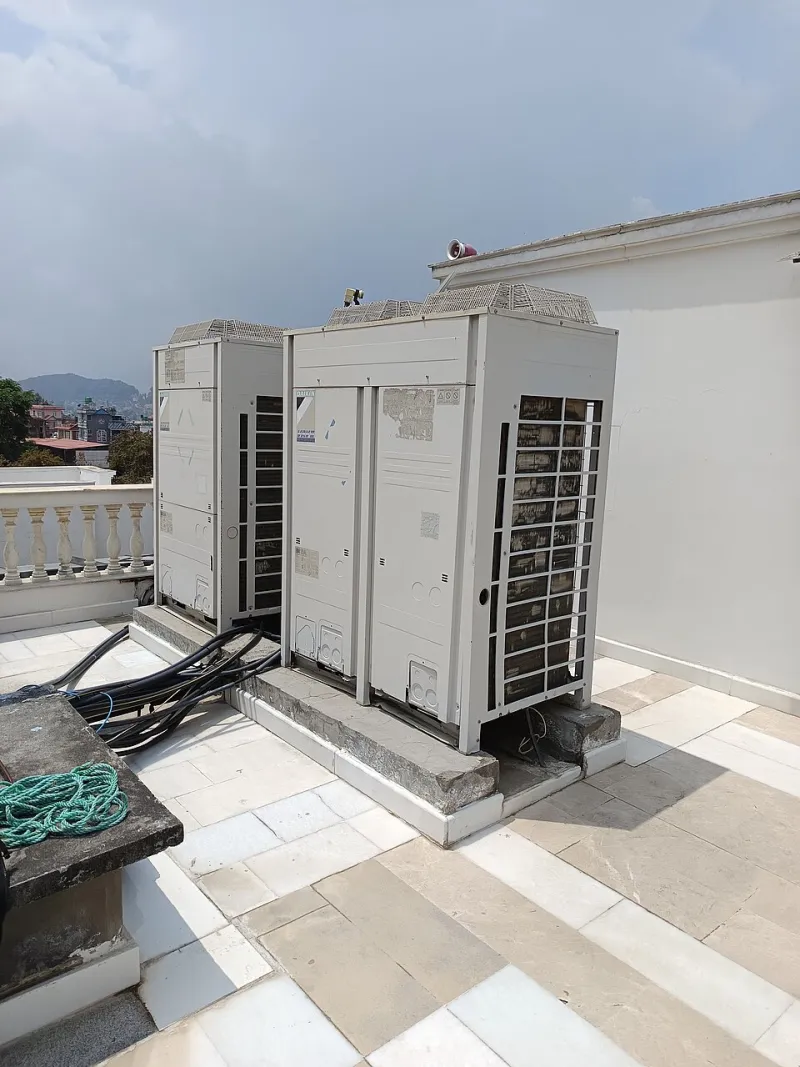
Photo: Daikin HVAC Installation And Repairing Center Pvt. Ltd, CC0, via Wikimedia Commons
Most commercial air conditioning contracts are signed once and read once — usually in a hurry, usually by someone with a dozen other decisions to make. That is precisely when the trouble starts. In our experience reviewing agreements across the Midlands and beyond, the disputes that reach us rarely involve dramatic failures. They involve words: what 'annual servicing' actually means, and whether that failed compressor counts as an 'inclusive part'.
A Costly Ambiguity in Nottingham
Consider a case we were asked to untangle last year. A Nottingham-based logistics firm had a maintenance agreement covering four rooftop systems across its warehouse. The contract promised 'annual servicing inclusive of parts'. When a condenser unit failed in its second summer, the firm assumed the replacement was covered. The contractor disagreed — arguing that 'inclusive parts' referred only to consumables fitted during routine servicing, not component replacement.
The disagreement ended up costing the firm roughly £18,000 in replacement works, legal correspondence, and a temporary rental chiller to keep temperature-sensitive stock viable. The contract, on close reading, supported the contractor's interpretation. The word 'servicing' was doing all the work, and nobody had defined it.
Why 'Annual Servicing' Is Not a Specification
The phrase appears in dozens of agreements we see, and it is almost always undefined. Does it mean one visit per contract year, or per calendar year? Does it include both an F-Gas refrigerant leak check — a legal requirement for most commercial systems — and a full mechanical inspection? Does it cover coil cleaning, or only a visual assessment?
Without a schedule of works attached, 'annual servicing' can be honoured in the letter and broken in the spirit. A fifteen-minute visual check technically satisfies the clause. It will not, however, catch the early signs of the failure that arrives eighteen months later.
The 'Inclusive Parts' Trap
The second recurring ambiguity concerns parts. Sensible contracts distinguish clearly between:
- Consumables — filters, cleaned contacts, replacement fuses fitted during routine visits
- Wear-and-tear components — fans, capacitors, sensors
- Major plant — compressors, heat exchangers, control boards
Contracts that simply say 'parts included' invite each party to assume the most favourable reading. When the invoice arrives, the most favourable reading turns out to be the contractor's.
A Plain-English Checklist for Your Next Agreement
Before signing any HVAC service agreement, we advise facilities managers to confirm the following in writing:
- A defined service schedule — number of visits, tasks per visit, and reference to manufacturer specifications.
- F-Gas compliance explicitly stated — leak checks at statutory intervals, with records supplied.
- A three-tier parts definition — consumables, wear items, and major components, each with clear responsibility.
- Response times for call-outs — and what happens when they are missed.
- Exclusions listed, not implied — damage from misuse, third-party interference, and so on.
- A defined contract year — tied to a date, not to 'anniversary of commencement'.
The Wider Point
These disputes are not confined to rogue operators. Well-intentioned contractors and clients genuinely interpret the same sentence differently, and the gap only widens when a system fails under load in July. Clarity costs nothing at the drafting stage and a great deal afterwards.
If you are reviewing an existing agreement and cannot answer the six points above from the document alone, that is your answer. Ask for the schedule in writing — ideally before the compressor, not after it, makes the position urgent.