A Few Thousand Pounds and One Plug Socket: Cooling Small Commercial Units Without Breaking the Lease
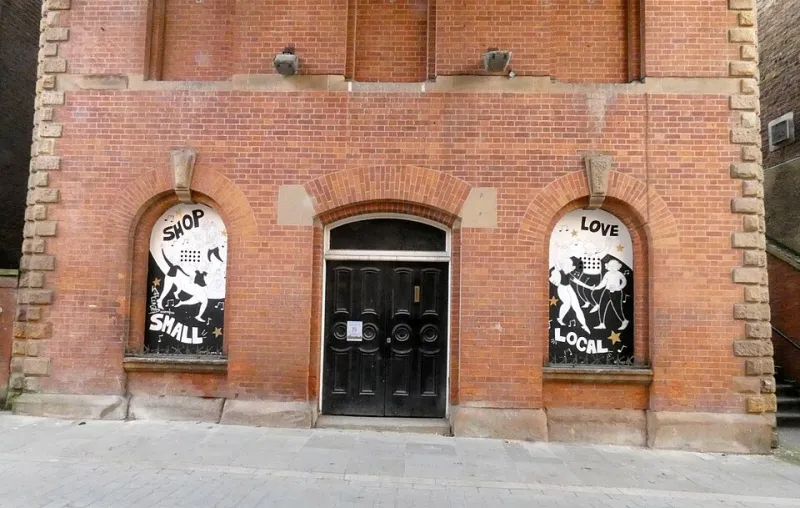
Photo: Gerald England , CC BY-SA 2.0, via Wikimedia Commons
The Reality of the Converted Unit
Walk down any British high street and you'll pass dozens of small commercial units carved out of Victorian terraces, former banks, butcher's shops and townhouses. The space above the ceiling is a maze of joists, old lath and plaster, and shared voids with the flat next door. There is no plant room, no riser, and often no landlord enthusiasm for anyone drilling through a party wall.
Yet the sun still comes out in July, the till still sits under a south-facing window, and customers still ask for the door to be propped open. For the tenant of a 40 to 80 square metre unit, the question isn't what the ideal system would be — it's what can actually be fitted, funded and maintained this side of the next rent review.
What Your Money Actually Buys
Let's be honest about the brackets, using figures typical of UK installations in 2025.
Under £1,500 — the portable trap. A decent monobloc portable unit from a reputable brand will cool a small salon or stockroom adequately, but it comes with compromises that compound quickly. The hose dumps hot air out of a window that then leaks warm air back in; the compressor is noisy enough to fight a conversation across a coffee counter; and the running costs per hour are roughly double those of a fixed split. Portables are a bridge, not a destination. If you buy one, buy it knowing you'll replace it within two summers.
£1,800–£3,500 — the single split, done properly. For most small units this is the answer. A wall-mounted indoor unit paired with an outdoor condenser, installed by an F-Gas certified engineer, will handle a café floor or a two-chair salon comfortably. The critical word is properly: a cheap online supply-only purchase followed by an informal install is where trouble starts. Refrigerant handling is regulated, warranties are voided by uncertified work, and insurers take a dim view of uncommissioned equipment above a till.
£4,000–£7,000 — multi-split territory. Two or three indoor heads running from one outdoor unit suit converted buildings where the trading area, office and stockroom have different heat loads. It's more than many sole traders want to spend, but it's the point where climate control stops being a summer sticking-plaster and starts being part of the building's fabric.
£8,000 and up — VRF-lite. True variable refrigerant flow is generally overkill at this scale, but simplified single-pipe systems marketed as VRF-lite can make sense for slightly larger units or tenants planning to stay a decade. If your fit-out budget already runs to five figures, have the conversation. If it doesn't, don't feel you're missing out.
The Consent Conversation Nobody Wants to Have
Before any quote is signed, three questions need answers — and they're questions about paperwork, not pipework.
What does the lease say? Many commercial leases require landlord consent for alterations, and external condensers are almost always an alteration. A landlord who says no to a rooftop unit may say yes to a discreet rear-wall placement. Get consent in writing before committing.
Is the building listed or in a conservation area? External condensers visible from the street in a conservation area frequently need planning permission, and listed buildings need listed building consent for anything fixed to the fabric. Your local authority's planning portal will tell you within an hour's research. Installing first and asking later is an expensive way to learn this.
Who pays for the electricity? A heat pump system adds a meaningful load. Check your metering arrangement — a unit on a landlord's supply with a fixed service charge has no incentive to run the system efficiently, and one on a sub-meter at inflated rates will quietly erode the savings.
The Running-Cost Traps Hidden in the Sticker Price
The regret scenarios in small-unit cooling rarely involve the installation itself. They involve what happens afterwards.
The first trap is the heating-mode habit. Every fixed split sold in the UK is a heat pump, and it's tempting to use it as primary heating in winter. In a poorly insulated unit, that's a recipe for a bill that dwarfs the summer savings. Air conditioning is best understood as a summer system that happens to take the edge off a shoulder-season morning — not a replacement for the gas boiler or panel heaters.
The second trap is skipped servicing. A split system with a clogged filter and a dirty coil can consume 20–30% more electricity for less cooling, and a small unit with a single outdoor condenser has no redundancy when it fails in a heatwave. An annual service — typically £100–£200 plus refrigerant checks where the F-Gas thresholds apply — is cheap insurance. Note that systems holding 5 tonnes of CO₂-equivalent or more of refrigerant require formal checks under F-Gas rules; most single splits fall below this, but multi-splits may not.
The third trap is sizing by guesswork. An oversized unit in a small shop short-cycles, dehumidifies poorly and wears out faster. An undersized one runs flat out and never catches up. Any installer worth hiring will do a basic heat-load calculation covering glazing, occupancy and equipment — if they quote on the phone without asking a single question about the space, take that as the answer.
A Sensible Sequence for the Sole Trader
For a tenant with £2,500 and a south-facing shopfront, the sequence that works is this: check the lease and planning position first; get two or three quotes from F-Gas certified installers who visit in person; choose a reputable brand with parts availability; place the condenser where noise won't trouble neighbours or planners; and book the first service in the diary before the installer leaves.
The unit that gets installed carefully and maintained annually will still be quietly working in year ten. The cheap portable bought in a July panic will be in a cupboard by September — and the money spent on it won't come back.
Cool heads, as ever, beat hot tempers. Especially in July, at two o'clock, with a queue at the counter.