Night Shift: What Our Emergency Engineers Wish You Knew Before the 4am Call-Out
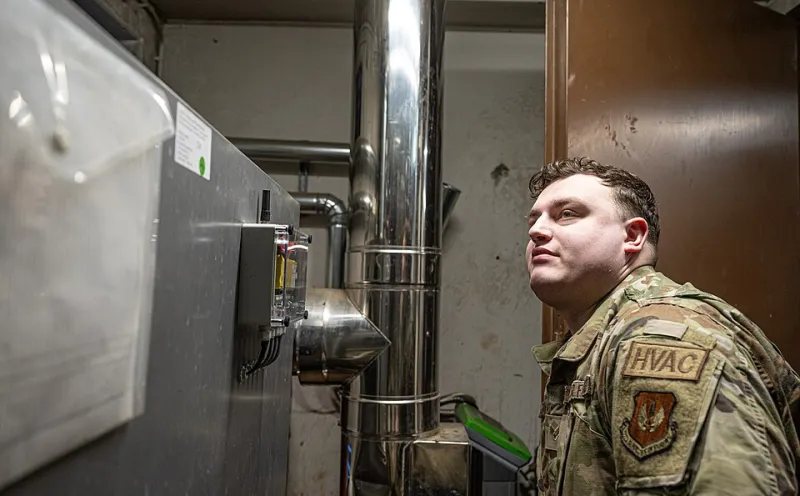
Photo: U.S. Air force photo by Senior Airman Thomas Karol, Public domain, via Wikimedia Commons
The call came in at 04:12. A hotel in central Manchester, one of two rooftop units down, function rooms booked for a wedding conference by mid-morning. By the time the engineer had climbed the access ladder with a headtorch and a multimeter, the diagnosis was already half-written in the service history — or rather, in the absence of one.
This article follows the shape of a typical overnight emergency rota, because the pattern is instructive. Failures that wake people up at four in the morning are rarely sudden. They announce themselves weeks in advance, in small ways, to anyone who happens to be listening.
The Night's Typical Caseload
Emergency call-outs across our contract base cluster into three familiar categories.
The failed rooftop unit. Hotels, retail parks and office blocks rely on packaged rooftop systems that run quietly for years — until a contactor welds shut, a fan bearing seizes, or a condenser choked with pigeon nesting material trips the unit on high discharge pressure. Summer storms and heat spikes accelerate the decline. The failure is electrical or mechanical, but the root cause is usually airflow that nobody has measured since the last service, whenever that was.
The overheating comms room. A server cupboard or comms room humming along on a dedicated split system is a business's least glamorous single point of failure. When that split unit loses gas, or its filter blocks and the room climbs past 30°C, the outcome is not an uncomfortable morning — it is a hard-down network, lost trading hours and, in some sectors, a reportable incident.
The cold store alarm. For food producers, wholesalers and pharmaceutical depots, a refrigeration alarm at night is a countdown. Product at risk, temperature records under scrutiny, and salvage decisions that get more expensive by the hour. These systems are usually well maintained because the stakes are obvious — but the failures we attend are often ancillary: a door heater, a defrost timer, a condensate line frozen solid.
What the Call-Out Log Actually Shows
Ask any engineer to review a year of emergency jobs and a pattern emerges. A substantial proportion of night-time failures trace back to issues that a routine service visit would have flagged: degraded capacitors drifting out of tolerance, filters at the end of their life, condensate pumps on borrowed time, refrigerant levels quietly low and compressors working harder as a result.
The economics are not subtle. A planned preventative visit costs a fraction of an out-of-hours call-out — which typically carries premium labour rates, parts at short-notice prices, and the unquantified cost of the disruption itself. A hotel relocating a conference, a wholesaler writing off stock, an e-commerce firm offline until dawn: the repair invoice is rarely the largest line.
There is also the compliance dimension. Under F-Gas regulations, operators of equipment containing fluorinated refrigerants must hold proper leak-check records. Reactive operators frequently discover gaps in that paperwork precisely when an emergency inspection or insurance query demands it.
The Warning Signs You Can Spot This Week
You do not need a refrigeration qualification to notice that a system is drifting towards failure. Before the phone rings at 4am, walk your plant and check:
- Noise. New rattles, grinding or humming that has changed pitch in recent weeks. Bearings and compressors rarely fail silently.
- Filters and airflow. Weak air from grilles, or filters you cannot remember being changed. Restricted airflow is the most common ancestor of serious faults.
- Condensate. Water stains, dripping pipework or full drip trays — signs a drainage line is blocking.
- Temperature stability. Rooms that take longer to cool, or cold store temperatures sitting nearer the alarm threshold than they used to.
- Error codes and trips. A unit that has 'reset itself' once is a unit that will eventually refuse to.
- The service date. If you cannot name the month your critical systems were last professionally inspected, that is the finding.
From Reactive to Planned
The businesses that rarely appear on an emergency rota share a habit: they treat climate control as infrastructure, not furniture. Annual or six-monthly servicing, filter regimes, and simple remote monitoring on the systems whose failure would hurt most — comms rooms, cold stores, critical plant.
None of this eliminates breakdowns entirely. Machinery fails. But it converts the 4am catastrophe into a daytime, planned intervention with parts on the van and no wedding in the function room at nine.
If your building's critical cooling has gone quiet — in the sense that nobody has looked at it in a year — that silence is worth breaking. Book a maintenance review before the season that will test it. Your night-time self, and your engineer's, will both be grateful.